Starting to find some good articles to use for our project and the paper later on in the summer. I'm going to aggregate them here for my own use :-P
These articles will be good for pointing out the existence of language barriers and the problems they cause in the medical profession:
Lost in translation? pediatric preventive care and language barriers
http://www.sciencedirect.com/science/article/pii/S0022347605011194
Language barriers and the use of interpreters in the public health services. A questionnaire-based survey
http://www.sciencedirect.com/science/article/pii/S0738399110002697
One of the ideas we've been throwing around was a what-if scenario where ambulances could have a 3G connection and send information from the tablet to the hospital before the patient arrives. It turns out this has already been an idea.
http://v-scheiner.brunel.ac.uk/bitstream/2438/2430/1/Ambulance%203G.pdf
We'll have to see if the Rochester area ambulances have 3G connections.
I am also interested in the translation aspect of the project. I want to make sure whatever translation we're using will be correct. Often times machine translation will have errors. This is obviously unacceptable for medical practice. We may need to look at simply providing hard-coded translation for the forms and leave MT for the open ended, less-important questions.
open source translation: http://www.apertium.org/
Wednesday, June 8, 2011

Tuesday, June 7, 2011
First EMT
So I'm doing research again this summer. This time around I'm working on First EMT. First Encounter Medical Translator will be an EMT assistant providing several multilingual or language independent tools for first responders. I'm going to be working with my buddy JT throughout the summer. You can follow his blog here: http://www.jtmengel.com.
Medical professionals today run into problems with patients who do not speak English. Obviously they must help these people but communication can be very difficult. We're going to design a tablet-based system that will allow first responders to gather data in a number of different languages. It will also have a diagram of a person where a patient can zoom in and let an EMT know where they're injured. We may also add a page where an EMT can pull up common questions in several different languages so they can verbally ask things like "who is your primary doctor?" or "do you have any allergies?".
This first week we will be writing up the design documents and figuring out exactly what our user experience is going to be. I'm also going to be researching options for translation since Google is dropping their translation API (link). Moses looks like a good alternative. I'll be posting more information on it as I learn more.
I'm very excited about this project and can't wait to getcracking hacking.
Medical professionals today run into problems with patients who do not speak English. Obviously they must help these people but communication can be very difficult. We're going to design a tablet-based system that will allow first responders to gather data in a number of different languages. It will also have a diagram of a person where a patient can zoom in and let an EMT know where they're injured. We may also add a page where an EMT can pull up common questions in several different languages so they can verbally ask things like "who is your primary doctor?" or "do you have any allergies?".
This first week we will be writing up the design documents and figuring out exactly what our user experience is going to be. I'm also going to be researching options for translation since Google is dropping their translation API (link). Moses looks like a good alternative. I'll be posting more information on it as I learn more.
I'm very excited about this project and can't wait to get
Tuesday, February 1, 2011
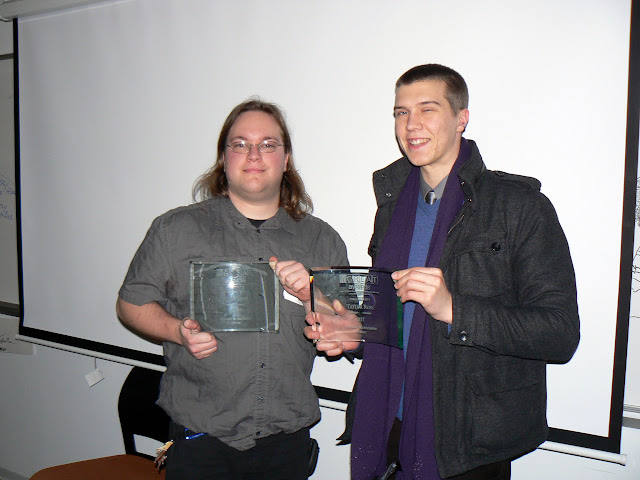
Rochester GREAT Student Achievement Award
So Justin, Fran, and I received a Rochester GREAT Student Achievement Award tonight for our work with Open Video Chat. Thanks to Remy DeCausemaker and Steven Jacobs for making this possible. Special thanks to our project advisors Luke Macken and Mel Chua :D

p.s. Sorry about the squinty face, I can't deal with camera flash :(
Friday, January 28, 2011
PHP: SUCCESS!
I've got an upload form working on the Rock Climbing Club staging server. As soon as I get the time I'll create and populate a database on the production server and push this live! Now officers will be able to upload photos with the click of a button. Next I want to look at possibly moving to a Flickr API or, if that fails, write a graphical interface with delete functionality. If you haven't yet, check out the club's website! http://www.rit.edu/rocks/ Now with 100% faster picture uploads!
Monday, January 24, 2011
PHP mini-project Update
I hit a small roadblock this weekend trying to get file uploading to work. That plus my AI homework really slowed down the project. I'm still banging away at it. Today I managed to get uploads to the web server. Next steps: Get the uploads to the right place. Password protect it! (O_O) Then I'm going to get the app pushing information to a database. From there I'll get the front page of the website reading information from that database.
Thursday, January 20, 2011
PHP: Photo Hero Project
So I'm the webmaster of the RIT Rock Climbing Club. What this basically means as far as the club is concerned is that I'm the only one that knows what a terminal window is. I figure since I know a thing or two more than that I should write some code to help future members of the club. So here's my idea:
Right now the club's front page has a slideshow of club members doing club-y stuff.(link) The members of the club wish to be able to change the images in the slideshow from time to time. Right now the current system is for them to send me an image. I crop the image to the right resolution and send it server side using sftp. Then I have to modify the index.php file to include the new image + alt text. The final step is using RIT's web manager to push everything to the production server. This is all really basic and easy since I program. However in the future the club might not have a programmer available to do this.
My goal this weekend is to create a web interface for uploading and deleting images from the slide show. This should allow club admins to easily modify the front page of the website.
Goals:
Right now the club's front page has a slideshow of club members doing club-y stuff.(link) The members of the club wish to be able to change the images in the slideshow from time to time. Right now the current system is for them to send me an image. I crop the image to the right resolution and send it server side using sftp. Then I have to modify the index.php file to include the new image + alt text. The final step is using RIT's web manager to push everything to the production server. This is all really basic and easy since I program. However in the future the club might not have a programmer available to do this.
My goal this weekend is to create a web interface for uploading and deleting images from the slide show. This should allow club admins to easily modify the front page of the website.
Goals:
- Simple web interface to upload and delete images from the server
- RIT LDAP authentication using a database of admin user names
- Database storing image location on server + image information (photographer, alt text, etc)
- modified index.php with generic data structure filled with info from the database
I only have passing knowledge of both PHP and SQL so this whole project should be rather interesting. I don't think it's going to be incredibly hard. Most of the work should be researching how to do the things I want in PHP.
Useful links:
- RIT LDAP PHP http://bjcpgd.cias.rit.edu/wordpress/archives/6
- PHP uploading http://www.tizag.com/phpT/fileupload.php
- PHP Database http://www.devshed.com/c/a/PHP/Website-Database-Basics-With-PHP-and-MySQL/
Wednesday, December 1, 2010
Engineer of the Future 3.0 Recap
After finals and a much needed break I'm finally back to school. Here's a much needed recap of the Engineer of the Future 3.0 conference:
This year the Engineer of the Future Conference was focused on how to motivate engineering students to prepare them better for industry.
The conference started off with a great presentation by Daniel Pink. Dan has presented in the past at TED talks.(link) Pink talked about how people work more efficiently when they are intrinsically motivated. He used multiple examples of experiments where participants were offered money to complete tasks. Given tasks where the solution was not clear the control groups that were not offered money actually completed their task faster than the groups with a monetary reward. When not offered a reward individuals work for themselves and tend to think outside the box.
Pink went on to talk about how some companies are experimenting with "20% time". Google is one such company that uses this new idea. Employees at Google are allowed to spend 20% of their time every week working on any project they choose. By giving employees control over what they work on Google has actually seen an increase in productivity.
Mr. Pink set the tone for the rest of the conference with his talk. Over the next 24 hours the buzz words at the conference were "intrinsic motivation".
After the opening talks we took a break for dinner and I went back to my hotel room to practice my presentation. The student Ignite session was later that night. The presentations were very interesting. One student talked about how he fixed up an antique car in high school. Another showed off a trebuchet she made with a club at school. I gave a presentation about FOSS@RIT and how we intrinsically motivate students by getting them involved in the open source community.(link)
The next day you could feel a new energy coming from the conference participants. Everyone was eager to talk and share their thoughts. Through the course of the day we were guided through group exercises to show just how powerful intrinsic motivation can be. This offered many opportunities to talk to people and network. Being an open source developer I took every opportunity I could to tell people about how open source projects can get students intrinsically motivated.
At lunch Sebastian Dziallas lead an Open Source meet and greet where we introduced a handful of students and professors to The Open Source Way. We were able to show off some of the tools and websites we use in the open source community and several people were interested. I was really happy with the amount of discussion we were able to have.
The second half of the day was more interactive workshops. The last activity we did was very cool. Tables of people had to work on a poster with questions having us examine an object. We didn't find out until the end that half the groups could choose whatever object they wanted and the other half had to examine a disposable razor. My group chose a bike lock. Our assignment involved many open ended questions like "what properties are important to the function of this object?". Our table discussion eventually moved to human nature and why we even need locking devices in the first place. Later when we talked to a table with a razor we found out that their experience was much different. Their poster had very technical restricting questions with specific answers. One question required them to apply a complex equation to determine a property of the plastic used in the razor. The people from this group seemed like they did not enjoy their experience at all. Their answers were short and just specific enough to get by. Our group had verbose answers because we actually liked what we were talking about and it was interesting to us.
So I came out of this conference with a new understanding of how to better motivate myself in my own work as well as how to get others motivated in their's. I think open source can be tied in closely to this idea of intrinsic motivation. When I took the HFOSS class at RIT we were allowed to pick what project we would work on for the entirety of the class. This allowed me to pick up Transbot, a project that actually matters to me. Instead of working on some calculator or calendar program I was able to work on a project that will help others.
I think concepts from open source can be applied in education in many fields. In project based classes students can be given the option of picking up a project of their choice. Obviously the project must apply to the course material. By allowing students to take control of their education they will be intrinsically motivated to work hard and learn.
This year the Engineer of the Future Conference was focused on how to motivate engineering students to prepare them better for industry.
The conference started off with a great presentation by Daniel Pink. Dan has presented in the past at TED talks.(link) Pink talked about how people work more efficiently when they are intrinsically motivated. He used multiple examples of experiments where participants were offered money to complete tasks. Given tasks where the solution was not clear the control groups that were not offered money actually completed their task faster than the groups with a monetary reward. When not offered a reward individuals work for themselves and tend to think outside the box.
Pink went on to talk about how some companies are experimenting with "20% time". Google is one such company that uses this new idea. Employees at Google are allowed to spend 20% of their time every week working on any project they choose. By giving employees control over what they work on Google has actually seen an increase in productivity.
Mr. Pink set the tone for the rest of the conference with his talk. Over the next 24 hours the buzz words at the conference were "intrinsic motivation".
After the opening talks we took a break for dinner and I went back to my hotel room to practice my presentation. The student Ignite session was later that night. The presentations were very interesting. One student talked about how he fixed up an antique car in high school. Another showed off a trebuchet she made with a club at school. I gave a presentation about FOSS@RIT and how we intrinsically motivate students by getting them involved in the open source community.(link)
The next day you could feel a new energy coming from the conference participants. Everyone was eager to talk and share their thoughts. Through the course of the day we were guided through group exercises to show just how powerful intrinsic motivation can be. This offered many opportunities to talk to people and network. Being an open source developer I took every opportunity I could to tell people about how open source projects can get students intrinsically motivated.
At lunch Sebastian Dziallas lead an Open Source meet and greet where we introduced a handful of students and professors to The Open Source Way. We were able to show off some of the tools and websites we use in the open source community and several people were interested. I was really happy with the amount of discussion we were able to have.
The second half of the day was more interactive workshops. The last activity we did was very cool. Tables of people had to work on a poster with questions having us examine an object. We didn't find out until the end that half the groups could choose whatever object they wanted and the other half had to examine a disposable razor. My group chose a bike lock. Our assignment involved many open ended questions like "what properties are important to the function of this object?". Our table discussion eventually moved to human nature and why we even need locking devices in the first place. Later when we talked to a table with a razor we found out that their experience was much different. Their poster had very technical restricting questions with specific answers. One question required them to apply a complex equation to determine a property of the plastic used in the razor. The people from this group seemed like they did not enjoy their experience at all. Their answers were short and just specific enough to get by. Our group had verbose answers because we actually liked what we were talking about and it was interesting to us.
So I came out of this conference with a new understanding of how to better motivate myself in my own work as well as how to get others motivated in their's. I think open source can be tied in closely to this idea of intrinsic motivation. When I took the HFOSS class at RIT we were allowed to pick what project we would work on for the entirety of the class. This allowed me to pick up Transbot, a project that actually matters to me. Instead of working on some calculator or calendar program I was able to work on a project that will help others.
I think concepts from open source can be applied in education in many fields. In project based classes students can be given the option of picking up a project of their choice. Obviously the project must apply to the course material. By allowing students to take control of their education they will be intrinsically motivated to work hard and learn.
Subscribe to:
Posts (Atom)